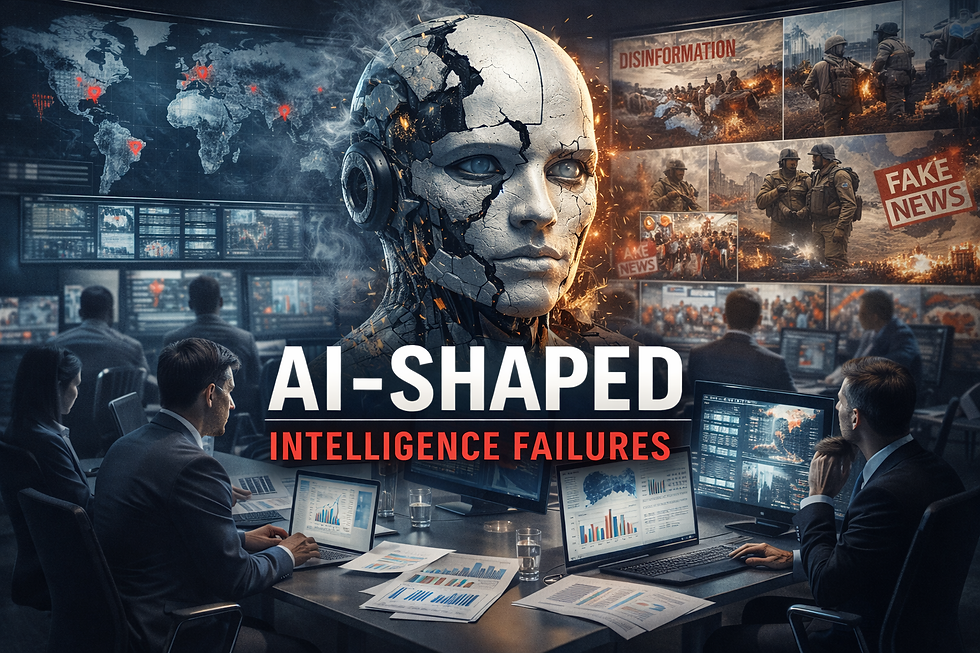
AI May Not Replace Analysts. It May Break Them First.

Why cognitive overload, synthetic media, AI dependence, and the erosion of lantern consciousness may become the most dangerous threat facing OSINT, threat intelligence, and digital investigations.
This article builds on my earlier warnings about how AI may erode critical thinking in OSINT, how algorithmic systems shape emotional and cognitive behavior, and how the future of open source intelligence will be defined by more than tools alone.
It also takes inspiration from a recent public signal by Network Chuck — “I kind of hate AI…and it almost made me quit youtube” — that made the emotional and cognitive strain of the AI environment unusually visible.
Artificial intelligence is not just changing how intelligence work gets done.
It may be degrading the minds of the people doing it.
In open source intelligence, threat intelligence, journalism, investigations, and digital risk analysis, the greatest near-term AI threat may not be automation at all. It may be the slow erosion of human judgment under conditions of overload, synthetic noise, algorithmic pressure, and machine-shaped dependence.
The real danger is not simply that AI can generate endless content.
The real danger is that it can help create an information environment so fast, so persuasive, so frictionless, and so mentally exhausting that analysts stop thinking as rigorously as the moment demands.
That is not just a workflow problem.
It is a cognitive security problem.

The Warning
The next major risk to OSINT, intelligence analysis, digital investigations, corporate security, and investigative journalism may not be a technical failure.
It may be a human one.
Not because people suddenly become incompetent.
Not because analysts stop caring.
Not because machines become conscious.
But because the modern information environment is increasingly optimised to produce five dangerous effects at once:
Volume
Too much information, too quickly, with too little time to assess it.
Velocity
Constant updates, summaries, alerts, clips, reposts, AI commentary, and synthetic amplification.
Ambiguity
A collapsing distinction between authentic, manipulated, low-quality, and AI-generated content.
Dependence
A growing habit of outsourcing search, synthesis, wording, prioritization, and even interpretation to machines.
Fatigue
A gradual erosion of focus, skepticism, patience, and analytical discipline.
Combined, these pressures create something far more dangerous than simple burnout. They create a condition in which the human layer of intelligence becomes easier to rush, easier to influence, easier to satisfy with plausible output, and easier to detach from rigorous tradecraft. This is not just an efficiency issue. It is a cognitive security issue.
The Wrong Question Has Dominated the AI Debate
For too long, the central question has been: Will AI replace analysts?
That question is dramatic, clickable, and incomplete.
A more urgent question is this:
What happens when analysts remain in the loop, but their cognitive performance, confidence, and judgment are gradually degraded by AI-shaped environments?
That is the scenario many organisations are not prepared for. Because replacing an analyst is visible.
Degrading an analyst is not.
Replacement triggers resistance.
Degradation often looks like adaptation.
It can even look like progress.
More reports produced.
More alerts reviewed.
More dashboards filled.
More summaries generated.
More content processed.
From the outside, the machine-human system appears more productive.
From the inside, it may be becoming less thoughtful, less skeptical, less original, less resilient, and less capable of high-quality judgment under uncertainty.
That is a dangerous trade, especially in OSINT or broader Intelligence work.
Because OSINT was never supposed to be a speed contest. It was supposed to be a thinking discipline, as argued earlier in OSINT Is Still a Thinking Game.
This Is Bigger Than Technology
The discussion around AI is still too narrow. Most public debate remains trapped inside old frames:
productivity
efficiency
automation
job replacement
cost reduction
competitive advantage
Those frames miss the deeper issue.
The more serious question is not only what AI does to workflows. It is what AI does to the conditions under which people think.
That is a much bigger problem.
Because in intelligence work, the quality of the outcome is inseparable from the quality of the mind producing it.
A system can be faster and still be worse.
A workflow can be smoother and still be more dangerous.
An analyst can be more assisted and still be less perceptive.
That distinction matters because modern AI is not entering a stable ecosystem.
It is entering a world already distorted by misinformation, disinformation, synthetic media, algorithmic anxiety, manipulated virality, emotional amplification, and adversarial narrative shaping. That pressure does not appear from nowhere. It grows inside the same platform dynamics described in The Algorithmic Anxiety Machine: Social Media Algorithm Dangers.
AI does not simply add capability to that environment, it scales the pressure inside it.
OSINT Was Already Vulnerable Before AI Flooded the Zone
Open source intelligence has always had a structural weakness.
It is easy to confuse access to information with the ability to produce intelligence.
Collection feels productive.
Discovery feels exciting.
Tooling feels advanced.
Output feels useful.
But intelligence is not collection.
Intelligence is not scraping, searching, summarising, clustering, or extracting.
Intelligence is the disciplined process of assessing information, testing assumptions, validating sources, building context, identifying gaps, challenging interpretations, and producing judgments that survive scrutiny.
That work depends on human cognition.
Not just technical capability.
Not just models.
Not just dashboards.
And that is exactly what may now be under pressure.
This concern is part of a broader pattern already outlined in Critical Thinking Collapse 2.0: AI’s Impact on OSINT, where the warning was not merely that AI accelerates OSINT workflows, but that it can weaken the habits of skepticism, patience, and reasoning that make those workflows meaningful.
AI does not enter a healthy information ecosystem.
It enters one already shaped by propaganda, outrage cycles, low-context content, coordinated influence, emotional manipulation, and incentives that reward speed over reflection.
Now add:
Industrial-scale content generation.
AI-written commentary.
Synthetic summaries.
Automated translations.
Recommendation systems that amplify emotional salience.
Institutional pressure to do more because “the tools are faster now.”
This is not just a tooling upgrade.
It is a stress test on the human nervous system inside the intelligence cycle.
Warning Signs of AI Dependence
AI support can improve workflow. AI dependence quietly erodes tradecraft. The danger usually appears gradually, long before a team realizes its analytical standards are slipping.
Watch for these warning signs
Analysts are reading fewer primary sources
Original posts, videos, articles, datasets, and documents are increasingly replaced by AI summaries, extracted highlights, and generated digests.
Reports look polished but feel thin
The structure is clean. The language is smooth. But the work lacks depth, challenge, context, and genuine analytical tension.
Confidence is rising while verification is shrinking
Fluent outputs create a false sense of certainty. The more professional the summary sounds, the less likely it is to be challenged.
Analysts are editing machine output instead of building reasoning
The workflow shifts from investigation and assessment to refinement of machine-generated text.
Alternative hypotheses are disappearing
The first plausible explanation starts winning too often. Contradictory interpretations are raised less frequently.
Junior staff can produce deliverables but cannot explain their logic
This is one of the clearest signs of AI dependence. A report can be produced, but the reasoning behind it is weak, borrowed, or unclear.
Teams are moving faster but learning less
Output increases, but investigative instincts weaken because the hard cognitive work is no longer happening internally.
Primary-source friction is treated as inefficiency
The moment direct verification feels like a burden instead of a necessity, tradecraft is already under pressure.
Bottom line:
A team becomes AI-dependent not when it uses AI often, but when it slowly loses the ability, discipline, or patience to work well without it.
The Human Layer Is Becoming the Weakest Layer
The most overlooked AI risk in intelligence work is not technical hallucination.
It is human degradation through prolonged exposure.
When people operate in high-volume AI-shaped environments for long periods, several things start to happen, they begin to:
Mistake fluency for truth.
Trust summaries they should challenge.
Skim where they once read.
Edit instead of think.
Lose tolerance for ambiguity.
Prefer speed over depth.
Outsource the first draft of reasoning itself.
This does not happen all at once and that is why it is dangerous.
It happens gradually, and often invisibly:
The analyst still works.
The team still delivers.
The dashboard still updates.
The report still gets sent.
But the internal quality of thought may already be slipping.
These patterns reflect the same slow drift described in The Slow Collapse of Critical Thinking in OSINT Due to AI: not a dramatic collapse, but a gradual normalisation of weaker reasoning hidden behind faster workflows and more polished outputs.
In intelligence work, that slip matters. Because weak judgment rarely announces itself as weak judgment. It usually arrives disguised as efficiency, confidence, plausibility, and polished output.
That is how standards erode.
Spotlight Consciousness vs. Lantern Consciousness
One of the clearest ways to understand the cognitive risk of AI in OSINT is through the distinction between spotlight consciousness and lantern consciousness.
Spotlight consciousness is narrow, directed, task-specific attention. It locks onto a defined object, a question, a keyword, a target, a clip, or a claim. It is useful for execution. It helps analysts move quickly, isolate variables, process specific tasks, and retrieve answers efficiently.
Lantern consciousness works differently. It is broader, more open, more ambient, and less immediately task-bound. It notices peripheral detail, weak signals, contradictions, emotional texture, framing, absence, and anomalies. It is the mode of attention that often detects what the original question failed to ask.
OSINT requires both.
But AI-heavy workflows increasingly privilege spotlight consciousness.
The user asks.
The system answers.
The analyst extracts.
The process accelerates.
This creates a cognitive rhythm built around narrowing.
Find the summary.
Get the entity.
Pull the timeline.
Identify the location.
Generate the brief.
Move on.
That rhythm is efficient.
It is also dangerous when it becomes dominant.
Because much of serious intelligence work does not come from a narrow beam of attention alone. It comes from a wider field of awareness. It comes from noticing the thing that does not fit, the source that feels subtly off, the missing actor in the network, the emotional tone behind a coordinated narrative, the discrepancy between what is being said and what is being ignored.
That is lantern work.
And lantern work is exactly what synthetic, high-speed, AI-mediated environments can quietly suppress.
When investigators spend too much time in spotlight mode, several risks emerge.
They become:
Better at retrieving answers, but worse at sensing context.
Faster at extraction, but weaker at interpretation.
More responsive to prompts, but less receptive to ambiguity.
Efficient at handling information, but less capable of inhabiting the uncertainty where deeper insight often begins.
This matters because many of the most important OSINT breakthroughs do not arrive as direct answers to direct questions.
They emerge indirectly:
A strange timestamp.
An unnatural phrasing.
A mismatch between visual and narrative cues.
A sudden shift in tone across accounts.
A pattern that only becomes visible when attention is allowed to widen.
AI can support spotlight consciousness extremely well.
It is far less suited to protecting lantern consciousness.
And yet lantern consciousness may be the part of the analyst’s mind that matters most in a polluted information environment.
If AI trains investigators to remain in a permanently narrowed, prompt-driven, extractive mode of attention, then the damage is not only technical.
It is cognitive.
The profession may still look productive on the surface while becoming less perceptive underneath.
That is one of the clearest pathways through which AI may weaken the human layer of intelligence before it ever replaces it.
AI excels at narrowing attention. OSINT often depends on widening it.
What This Looks Like in Practice
1. Spotlight finds the keyword. Lantern notices the narrative.
An analyst uses AI to identify all posts mentioning a protest location, extract the most shared claims, and summarise the dominant narrative.
That is spotlight work.
But lantern consciousness notices something else: the most amplified posts all use similar emotional framing, similar wording patterns, and similar timing windows. The issue is no longer just what people are saying. It is how the narrative is being shaped.
Without lantern consciousness, the analyst may map the conversation while missing the manipulation.
2. Spotlight confirms the location. Lantern questions the context.
An investigator geolocates a video correctly using visible landmarks, road layout, and signage.
That is necessary spotlight work.
But lantern consciousness notices that the clothing, weather, crowd behavior, and posting pattern do not align naturally with the claimed event context. The location may be correct while the narrative around the video is false.
Without lantern consciousness, the analyst proves the wrong thing.
3. Spotlight extracts entities. Lantern detects absence.
An AI system pulls names, usernames, locations, organizations, and links from a network of posts.
Useful.
But lantern consciousness asks what is missing. Why is a central actor absent from all references? Why do supposedly organic accounts avoid the same obvious detail? Why does a cluster of content look coordinated despite lacking overt cross-linking?
In intelligence work, absence can be as important as presence.
Spotlight tends to capture what is there. Lantern helps detect what should be there but is not.
4. Spotlight speeds up triage. Lantern protects against premature closure.
A threat intelligence team uses AI to process huge volumes of emerging incident data and quickly identify the most likely explanation.
Efficient.
But lantern consciousness slows the team down long enough to ask whether the “most likely” explanation is simply the most repeated, most emotionally salient, or most machine-legible one.
Without lantern consciousness, teams become vulnerable to premature closure: fast answers that lock in before real understanding develops.
The Next Information War May Be About Exhaustion, Not Persuasion
Traditional influence operations aim to persuade, radicalise, divide, or mislead.
That model still matters. But a more effective modern strategy may be simpler:
Exhaust the audience. Exhaust the analyst. Exhaust the investigator.
Flood them with:
content
claims
AI-generated narratives
endless clips
conflicting interpretations
emotional triggers
false urgency
semi-credible noise
highly shareable but low-context media
The goal is not always to convince. Often, the goal is to degrade resistance.
A cognitively fresh analyst may challenge weak information.
A cognitively exhausted analyst may merely process it.
A sharp team may question synthetic consensus.
A tired team may absorb it.
A disciplined investigator may slow down and validate.
An overloaded one may accept plausibility as sufficient.
That is the deeper threat.
The future of manipulation may depend less on perfect lies and more on perfectly engineered overload, a pressure pattern that sits squarely inside the logic explored in The Algorithmic Anxiety Machine: Social Media Algorithm Dangers.
Practical Examples: What This Looks Like in the Real World
To make this concrete, here is what the cognitive security crisis can look like in OSINT, threat intelligence, journalism, and security work.
Example 1: The Analyst Who Stops Verifying the Second Layer
An analyst receives a viral clip of unrest in a European city.
AI tools quickly summarise the event, suggest a likely location, identify hashtags, translate posts, and generate an incident brief.
Everything looks efficient.
The first layer appears solid.
But the second layer is where intelligence actually begins.
Is the video current?
Is the crowd size exaggerated by angle?
Are the translated slogans accurate in context?
Are the posting accounts authentic, coordinated, or opportunistic?
Is the apparent narrative organic or seeded?
An overloaded analyst, under pressure to move fast, may never get to that second layer.
The result is not necessarily total failure.
It is something more common and more dangerous:
A plausible but under-verified assessment that enters reporting, shapes decisions, and hardens into accepted reality.
Example 2: The Threat Intelligence Team That Starts Trusting AI Summaries
A corporate intelligence team monitors geopolitical developments affecting supply chains, executive travel, protests near company assets, and online narratives targeting the organization.
AI tools summarize thousands of articles, Telegram posts, X posts, blogs, and local sources.
This seems like a win.
But over time, the team begins relying on machine summaries as the primary layer of understanding.
That creates several risks:
Nuance disappears.
Local context gets flattened.
Sarcasm and coded language are missed.
Low-credibility sources are blended into polished outputs.
Confidence levels become detached from source quality.
The team still produces reports.
But the reports become narrower, more homogenised, and less investigative.
In other words:
More output.
Less intelligence.
Example 3: The Junior Investigator Who Never Builds Analytical Muscle
A junior OSINT practitioner enters the field in an AI-heavy environment.
They use AI to:
generate search strings
summarize documents
extract entities
propose links
write timelines
suggest hypotheses
draft conclusions
At first, this looks efficient. But a hidden problem develops. The practitioner never fully builds the internal habits that experienced analysts rely on.
They do not learn:
To sit with uncertainty.
How to recognise weak sourcing instinctively.
How to notice the strange detail that breaks the case open.
How to challenge the first explanation.
They become operationally capable, but cognitively shallow.
That is not a training win, it's long-term tradecraft loss.
Example 4: The Journalist Who Mistakes Synthetic Consensus for Reality
A journalist covering unrest, extremism, conflict, or online influence sees hundreds of aligned posts, reaction videos, explainers, AI-assisted articles, and commentary threads all pointing toward the same interpretation of an event.
The signal feels overwhelming.
But scale can create the illusion of truth.
If large amounts of synthetic or derivative content repeat the same frame, a false sense of consensus emerges. It begins to feel as though “everyone is saying this,” when in reality many sources may trace back to a few manipulated inputs, a few coordinated actors, or one misleading initial post.
A fatigued researcher may interpret repetition as confirmation.
It is not.
Sometimes repetition is just amplification wearing the mask of validation.
Example 5: The Security Team That Becomes Faster and Worse
A security team at a multinational adopts AI aggressively.
Daily monitoring becomes faster.
Reports become cleaner.
Executives are impressed.
Dashboards look modern.
Six months later, something subtle has changed.
Analysts are reading less raw material.
Fewer dissenting hypotheses are raised.
Confidence scores are copied forward.
Source criticism becomes lighter.
Briefings become more polished but less surprising.
Then a real incident emerges.
The team misses key early indicators because the system had quietly trained them to trust synthesis over friction, fluency over fieldcraft, and structure over skepticism.
This is how organisations become more efficient on paper while becoming more fragile in reality.
Before Trusting an AI Summary, Ask These Five Questions
AI summaries save time. They can also compress nuance, hide uncertainty, and introduce error with confidence. Before using any generated summary in OSINT, intelligence analysis, or investigative work, analysts should force a pause.
Five questions that matter
1. What are the original sources behind this summary?
If the source chain is unclear, the summary should not be treated as intelligence. It is polished text, not validated understanding.
2. What may have been removed, flattened, or oversimplified?
AI often strips away contradiction, sarcasm, uncertainty, emotional tone, and local context. Clarity can be artificial.
3. Does the summary clearly separate fact, inference, and speculation?
One of the biggest risks in AI-generated analysis is the blending of what is known, what is assumed, and what is guessed.
4. What would disprove this summary?
If no one asks what could break the machine’s narrative, the machine’s narrative starts becoming the default reality.
5. Have I personally checked enough raw material to trust this conclusion?
Not every source needs to be reviewed line by line. But if there is no direct contact with original material, judgment is being outsourced.
Operational rule:
Never allow an AI summary to become the final layer between the analyst and reality.
Why This Matters Beyond OSINT
This is not only an OSINT problem.
It affects:
journalists
researchers
investigators
due diligence teams
policy analysts
law enforcement support teams
corporate intelligence units
digital risk teams
trust and safety professionals
anyone whose job depends on separating signal from noise
In all of these domains, the same principle applies:
When the information environment becomes more synthetic, the quality of human judgment matters more, not less. And when human judgment begins to degrade, the consequences spread far beyond one report, one case, or one missed post.
They spread into:
policy
security decisions
media narratives
crisis response
public understanding
institutional trust
This is why the conversation must move beyond productivity.
The strategic question is no longer whether AI saves time.
The strategic question is whether AI-heavy environments are making human judgment more robust or more brittle.
The wider implications also connect to themes explored in The Next Five Years of OSINT: Trends, Innovations, and Challenges Transforming Investigative Landscape and The Kids Aren’t Alright and the Internet Knows It, both of which point to a future in which digital systems increasingly shape not only what people see, but how they think, react, and interpret reality.
Early Warning Signs Organisations Should Not Ignore
Most teams will not notice this crisis in dramatic form. It will show up quietly.
Warning signs include:
Analysts reading fewer primary sources.
Teams relying heavily on generated summaries without deep validation.
Declining patience for slow, ambiguous investigations.
Overconfidence in polished outputs.
Fewer alternative hypotheses raised in reporting.
More copy-editing of machine output and less original analytical reasoning.
Junior staff who can produce deliverables but struggle to explain how they reached conclusions.
Increasing fatigue, detachment, cynicism, and mental flattening among high-performing staff.
These are not just workflow symptoms.
They may be indicators of tradecraft erosion.
What Cognitive Security Means for OSINT Teams
Most teams protect systems, networks, devices, and data. That is no longer enough. They also need to protect the cognitive layer: the attention, judgment, skepticism, memory, and reasoning capacity of the people interpreting information.
Cognitive security is:
The protection of analysts and investigators from conditions that degrade clear thinking. In OSINT and intelligence environments, that means recognising that the threat is not only false information. The threat also includes the environments that make people easier to rush, mislead, fatigue, overload, or psychologically flatten.
For OSINT teams, cognitive security means defending against
Information overload
Too much content, too quickly, with too little time to validate.
Synthetic pollution
AI-generated text, images, video, personas, summaries, and narratives entering workflows faster than they can be authenticated.
False fluency
Machine-generated output that sounds authoritative enough to discourage challenge.
Analytical fatigue
The slow erosion of patience, skepticism, curiosity, and precision caused by high-speed, high-volume workflows.
Narrative pressure
Algorithmically amplified repetition, emotional framing, and synthetic consensus that distort judgment.
In practice, cognitive security requires
Protected time for verification
Not every workflow should be optimised for speed.
Direct contact with primary sources
Summaries should support source engagement, not replace it.
Structured challenge culture
Teams should routinely test assumptions, confidence levels, and alternative explanations.
Training in cognitive resilience
Analysts need more than tool fluency. They need habits that preserve judgment under pressure.
Leadership that rewards quality over output theater
If teams are praised only for speed, volume, and polished reporting, analytical standards will degrade.
Key principle:
The future of open source intelligence will not depend only on better tools. It will depend on whether teams can preserve human judgment inside increasingly machine-shaped information environments.
What Practical Defenses Look Like
A serious response does not require rejecting AI. It requires defending the human layer. That means building workflows that preserve cognition instead of quietly consuming it.
Separate assistance from judgment
Use AI for acceleration, not for final interpretation.
Collection support is not the same as analytical authority.
Force primary-source contact
Analysts should still engage directly with original material:
raw video
original posts
original articles
source chains
metadata
maps
archived layers
A team that only reads summaries becomes vulnerable.
Require second-layer verification
Any claim that matters should face structured challenge:
What is the source?
What is missing?
What would disconfirm this?
What alternative explanation fits?
Who benefits from this narrative?
Protect lantern consciousness, not just spotlight efficiency
Teams should absolutely use AI for triage, extraction, and speed.
But they also need deliberate space for wider perception.
That means slowing down long enough to notice:
what feels off
what does not fit
what is missing
what emotional framing is operating
what second-order implications are emerging
what the first question failed to capture
A team that optimizes only for spotlight consciousness becomes fast, but narrow.
A team that protects lantern consciousness preserves the wider awareness real intelligence work depends on.
Train for cognitive resilience, not just tool adoption
The future analyst needs more than prompt literacy.
They need:
skepticism
contextual reasoning
source criticism
temporal awareness
emotional discipline
comfort with uncertainty
resistance to synthetic fluency
Measure analytical quality, not just output volume
If leadership rewards only speed and quantity, degradation becomes inevitable.
The best intelligence teams are not always the fastest. They are often the ones most capable of slowing down at the right moment.
My Conclusion (for now)
The scariest version of the AI era is not one in which machines suddenly become human. It is one in which humans become easier to flatten.
More reactive.
More dependent.
More overwhelmed.
More fluent.
Less reflective.
Less skeptical.
Less resilient.
Less capable of independent judgment.
That is not a science-fiction outcome. That is a professional risk already taking shape.
The real threat is not simply that AI can flood the information environment with synthetic content. It is that it may also condition the people inside that environment to think in narrower ways.
Spotlight consciousness becomes overdeveloped.
Lantern consciousness begins to fade.
Analysts become better at extraction, worse at perception.
Faster at response, weaker at interpretation. In OSINT, that is not a minor shift in workflow. It is a direct threat to the kind of mind real intelligence work requires.
And once those mental habits weaken, everything downstream weakens with them:
Verification.
Assessment.
Warning.
Foresight.
Credibility.
Trust.
This is why the AI debate in OSINT and Intelligence work needs to change.
The future of OSINT will not be decided by who adopts AI the fastest.
It will be decided by who protects the human capacity to think clearly inside an information environment increasingly designed to make clear thinking harder.
That is the real battleground.
And it is already under attack.


Comments