From TikTok to the Streets? Why 17 October Could Matter for France

How a viral protest date can move from narrative to real-world mobilisation, convergence and possible escalation
Assessment date: 7 October 2026 • Analytical model: Narrative → Mobilisation → Convergence → Trigger → Escalation

KEY JUDGMENT 17 October should currently be treated as a potential convergence point, not as a coherent national movement. The strongest warning indicator is not additional social-media reach, but evidence that previously separate grievance networks begin sharing locations, logistics, infrastructure or the same triggering incident.
Stage | Score | Assessment |
Narrative | 3 — Mature | The 17 October frame is self-propagating and survives its original source. |
Mobilisation | 2 — Established | Specific calls, locations and action concepts exist, but distributed physical preparation is uneven. |
Convergence | 1 — Emerging | Several grievance communities coexist in the same environment, but operational linkage remains limited. |
Trigger | 2 — Elevated | Existing injuries, policing controversies and economic decisions provide highly salient trigger material. |
Escalation | 1 — Localised | Serious unrest exists in the student movement, but direct escalation attributable to the 17 October mobilisation is not yet demonstrated. |
1. Why this case matters
The 17 October mobilisation is analytically useful because it challenges a traditional assumption: that a protest becomes “real” only after an identifiable organisation, leadership structure or recognised movement formally calls for it.
In this case, the date appears to have emerged from a viral TikTok video by a user with no established connection to the historical Gilets Jaunes movement. It was then repeated by newly created or renamed accounts, AI-generated posters and content that gave the impression of an already established national mobilisation. [S1]
That origin does not determine the eventual effect. Once enough people recognise the same date, it can become a coordination mechanism in its own right.
The relevant intelligence question therefore changes from “Who organised this?” to “Is this narrative now producing coordinated behaviour?”
EVIDENCE / FOOTAGE — Origin and why the case is analytically unusual
[PRIMARY SOCIAL] Original V2 TikTok selecting 17 October — TikTok @v2.95
Primary-source post identified by Le Monde as the viral video that fixed 17 October as the proposed date. The post is especially useful because it shows the date emerging before any recognised national structure.
Open evidence: https://www.tiktok.com/@v2.95/video/7682939624343227681
[VERIFICATION] How a TikTok rumor about the Yellow Vests' return spread — Le Monde (19 Sep 2026)
Le Monde independently traces the call to V2, documents AI-generated Yellow Vest posters and identifies suspicious accounts created or renamed on the same day. It also records Viginum's assessment that foreign amplification was minimal at that stage.
Open evidence: https://www.lemonde.fr/en/politics/article/2026/09/19/how-a-tiktok-rumor-about-the-yellow-vests-return-spread_6757698_5.html
[OSINT ANALYSIS] Appels à manifester pour le 17 octobre: origins of the online mobilisation — TF1 Vérif (16 Sep 2026)
TF1 traces the same origin independently, reports the sequence between the first fuel-price video and the 17 October date, and analyses how the content spread from TikTok to X.
Evidence handling note: online reach is evidence of narrative propagation, not evidence of physical turnout. The case study keeps those two propositions separate.
2. Preconditions: the grievance environment
A mobilisation narrative is more likely to gain traction when it attaches itself to grievances that already exist. In France, the 17 October narrative is developing in an environment shaped by exceptionally high fuel prices, cost-of-living pressure, public-sector dissatisfaction and a major school protest movement.
On 7 October, the French government announced the release of 10 million barrels of diesel from strategic stocks to ease tight supplies and price pressure. [S5]
Separately, student protests that began in the Paris suburbs spread nationally over deteriorating school buildings, teacher shortages, overcrowding and wider inequalities. Reuters reported thousands of arrests, hundreds of injuries and clashes in multiple cities. [S3][S4]
These issues are not one movement. They are the grievance environment into which a simple coordinating narrative can be inserted.
EVIDENCE / FOOTAGE — The grievance environment before 17 October
[VIDEO] Students and teachers explain why they are protesting — Le Monde (1 Oct 2026)
Students and teachers in Saint-Denis, Lille and Bordeaux describe absent teachers, poor buildings and unacceptable classroom conditions. This is useful evidence of the underlying grievance before showing later disorder.
[REPORTING] High school students in Paris suburbs spark national protest
movement — Reuters (3 Oct 2026)
Documents the geographical spread of the school movement to more than a thousand schools and the support of teachers and unions.
Open evidence: https://www.reuters.com/world/high-school-students-paris-deprived-suburbs-spark-national-protest-movement-2026-10-03/
[ECONOMIC CONTEXT] France to release 10 million barrels of diesel from strategic stocks — Reuters (7 Oct 2026)
Direct evidence that fuel-price and diesel-supply pressure was sufficiently serious for the French government to release strategic reserves.
Open evidence: https://www.reuters.com/business/energy/france-release-10-mln-barrels-diesel-stocks-french-pm-says-2026-10-07/
3. Narrative: “17 October” becomes the story
Le Monde traced the date to a TikTok user identified as “V2”, who had posted about rising fuel prices and suggested a demonstration. In a subsequent video, viewed around 1.5 million times, he proposed 17 October because it was a Saturday and the start of the Toussaint school holidays. The user later said he was stepping back from organising the protest. [S1]
The date nevertheless continued to circulate. Le Monde identified numerous posters generated with AI and a cluster of accounts created or renamed on 9 September that promoted an apparently “official” national mobilisation using Yellow Vest imagery. Viginum, France’s service for detecting foreign digital interference, told Le Monde that it had found only very limited foreign amplification and no indication at that stage that foreign actors were driving the phenomenon. [S1]
Analytical lesson: a narrative can detach from its creator. When the date, slogan or symbol survives the withdrawal of its original source, narrative maturity has increased.
EVIDENCE / SOCIAL MEDIA — Narrative formation, amplification and synthetic legitimacy
[PRIMARY SOCIAL] V2 fuel-price video preceding the date selection — TikTok @v2.95
The immediately preceding V2 post proposed a “manifestation pour l’essence.” Together with the next post, it demonstrates the rapid sequence grievance -> proposal -> date.
Open evidence: https://www.tiktok.com/@v2.95/video/7682933191241518368
[PRIMARY SOCIAL] “Représentant des Gilets Jaunes” AI-generated mobilisation post — TikTok
Le Monde cites this post as an example of an account created on 9 September that published AI-generated Yellow Vest mobilisation content and accumulated substantial engagement.
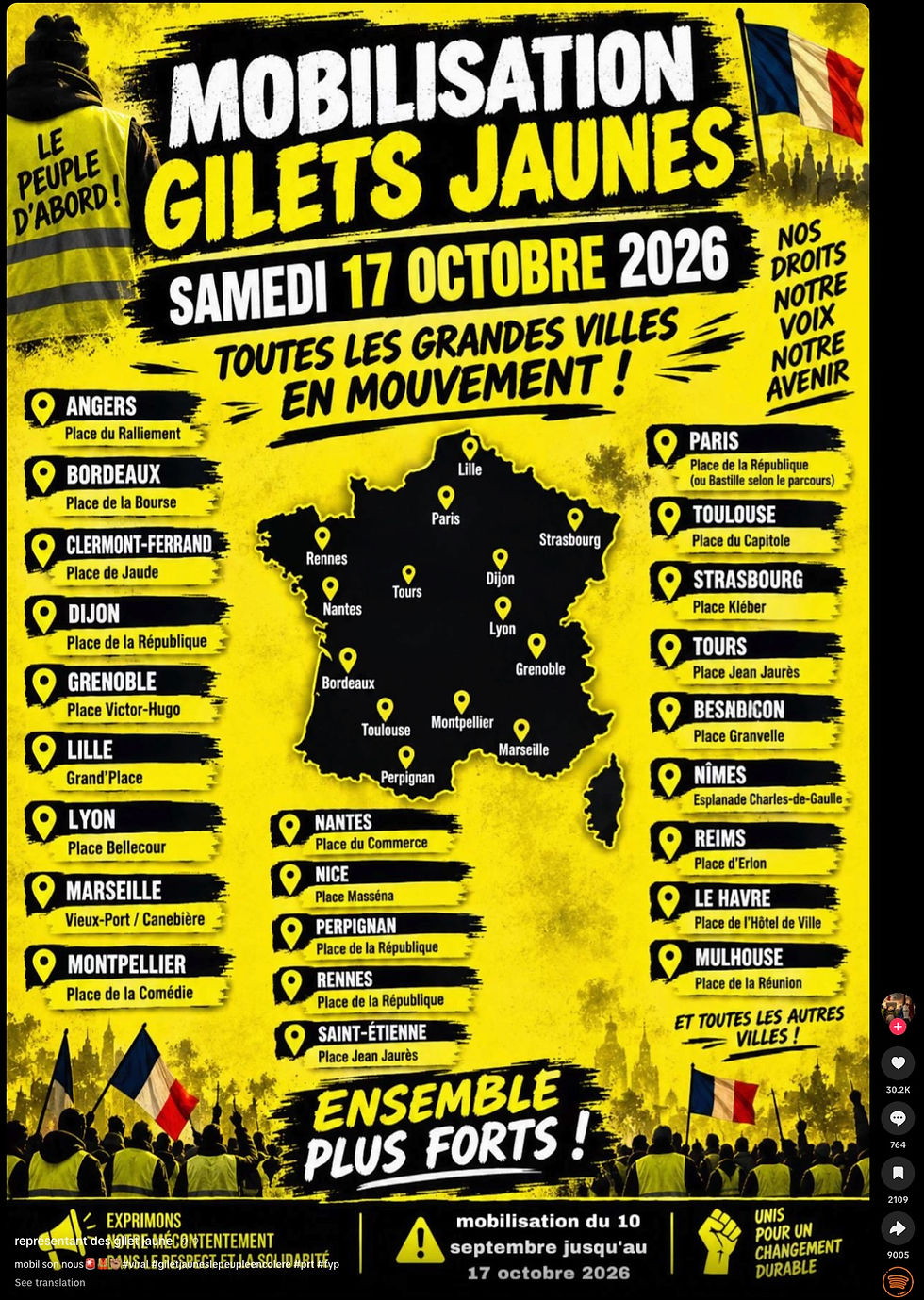
Open evidence:
[AMPLIFICATION DATA] TF1 / Sahar analysis of 17 October mentions on TikTok and X — TF1 Vérif (16 Sep 2026)
TF1 reports approximately 45 million views in seven days around the topic and shows the shift from TikTok trend-like content to harder-edged amplification on X. The same article contains screenshots of TikTok content and a platform-volume graphic.
4. Mobilisation: when conversation becomes preparation
The transition from narrative to mobilisation is visible when posts stop asking whether something should happen and start answering when, where and how. Proposed meeting points, local action maps, calls involving petrol stations or fuel infrastructure, transport coordination and identifiable local nodes are substantially more important than raw views, likes or reposts.
The 17 October ecosystem has crossed part of that boundary. Calls to mobilise in multiple cities exist, and the date has acquired enough recognition that established political and media actors discuss it. That supports a Mobilisation score of 2 rather than 1. The score is not yet 3 because broad, verified and independently functioning local logistics remain inconsistent and difficult to distinguish from performative online content.
EVIDENCE / FOOTAGE — From online talk to mobilisation signals
[VIDEO] Gilets jaunes: le grand retour le 17 octobre? — TF1 Info (14 Sep 2026)
Short video showing Yellow Vest gatherings already appearing in Paris and Bandol while 17 October circulated online. It is useful as an early online-to-offline indicator, while remaining cautious about scale.
Open evidence: https://www.tf1info.fr/societe/videos/video-gilets-jaunes-le-grand-retour-le-17-octobre-25919-2464118.html
[SOCIAL + MAP] Embedded V2 post and circulating city map — RTL (11 Sep 2026)
RTL reproduces the V2 TikTok and reports a widely circulated map naming prospective gathering cities including Paris, Lyon, Lille, Marseille, Bordeaux and others. This is stronger mobilisation evidence than a generic slogan because it introduces geography.
Analytical caution: a poster naming cities is evidence of mobilisation messaging. It is not by itself evidence that local organising capacity exists in each city.
5. Convergence: the critical stage
By early October, France was already experiencing a separate and substantial student protest movement. Public Sénat reported that unions and political parties had begun supporting the student mobilisation and explicitly examined whether the wider climate could produce a “convergence des luttes.” Its sources cautioned that the student and Yellow Vest/cost-of-living ecosystems remained different worlds with different demands. [S2]
This distinction is central. Convergence does not require ideological agreement. It can occur at several levels: narrative, temporal, spatial, operational and identity-based.
Convergence type | What it means | Current assessment |
Narrative | Different communities use a shared interpretation or grievance frame. | Emerging |
Temporal | Different communities orient activity around the same date. | Emerging |
Spatial | Different movements appear at the same physical locations. | Not established |
Operational | Groups share logistics, communications, routes or support infrastructure. | Limited evidence |
Identity | Participants increasingly describe themselves as one movement. | Not established |
The key insight: spatial or operational convergence can matter before ideological convergence. People do not need to agree on why they are there in order to occupy the same street, react to the same incident or generate the same public-order consequences.
EVIDENCE / FOOTAGE — Convergence becomes observable
[REPORTING] Are the school protests, unions and Yellow Vests moving toward “convergence des luttes”? — Public Sénat (5 Oct 2026; updated 8 Oct)
Directly examines whether the separate grievance ecosystems are beginning to overlap, while stressing that different constituencies still have different demands and organisational cultures.
Open evidence: https://www.publicsenat.fr/actualites/societe/blocage-des-lycees-syndicats-gilets-jaunes-se-dirige-t-on-vers-une-convergence-des-luttes
[VIDEO] Students, parents and CGT union members confront police in Paris — Euronews (6 Oct 2026)
Video visually demonstrates different constituencies occupying the same protest space. This is useful evidence of spatial and organisational overlap without implying a single unified movement.
Open evidence: https://www.euronews.com/video/2026/10/06/paris-police-clash-with-protesters-over-school-conditions
[PRIMARY OBSERVATION] “Ne rien lâcher jusqu’au 17 octobre” — Le Monde live reporting (6 Oct 2026)
Le Monde reported participants discussing convergence with workers and treating 17 October as a common horizon for continued mobilisation. This is stronger evidence of temporal convergence than generic online speculation.
[POST-ASSESSMENT UPDATE] Student leaders call further action including 17 October — Reuters (8 Oct 2026)
Published after the case study’s 7 October assessment date. Reuters reported that student leaders planned further protests, including a nationwide day of action on 17 October. This validates the direction of travel but must not be retroactively treated as evidence available on 7 October.
Open evidence: https://www.reuters.com/world/europe/french-school-blockades-persist-after-pms-unspecified-promises-2026-10-08/
POST-ASSESSMENT DISCIPLINE: The Reuters 8 October item is deliberately separated from evidence available on the 7 October assessment date.
6. Trigger: what can accelerate the system?
A trigger is an event that gives separate communities a common reference point and changes behaviour. The event itself can be a police action, arrest, injury, government decision, price shock, court ruling, viral image or misleading piece of media. The most important indicator is not virality inside one group, but rapid propagation across networks that previously had weak overlap.
The current French environment already contains candidate trigger material. Reuters reported that a 15-year-old lost his hand during the school protests after an incident involving a police dispersal grenade. On 7 October the government suspended the use of stun grenades against the student movement while investigations continue. [S4]
For the 17 October case, the trigger threshold would be crossed more clearly if the same incident were simultaneously adopted by student, union, Yellow Vest, fuel-price and broader anti-government networks and generated new calls to attend, blockade or expand activity.
EVIDENCE / FOOTAGE — Candidate triggers and reciprocal grievance
[REPORTING] 15-year-old loses hand during school-protest confrontation in Lens — Reuters (5 Oct 2026)
A severe injury with the potential to become a highly portable grievance object across networks. Reuters carefully attributes the detail about the grenade circumstances to local reporting and notes that an investigation was opened.
Open evidence: https://www.reuters.com/world/student-15-has-hand-blown-off-during-french-school-protests-local-press-reports-2026-10-05/
[POLICY RESPONSE] France suspends use of stun grenades in student protests — Reuters (7 Oct 2026)
Shows how a single incident can produce a national policy response and therefore increase the narrative salience of the trigger.
Open evidence: https://www.reuters.com/world/europe/france-suspends-use-stun-grenades-police-student-protests-2026-10-07/
[SOCIAL VIDEO / COUNTER-TRIGGER] Trainee police officer chased, knocked down and struck in Paris — RTL report on widely shared social video (2 Oct 2026)
Useful counter-evidence demonstrating that trigger narratives can form on multiple sides. Footage of violence against police can become a separate justification narrative for tougher policing, creating the conditions for a recursive escalation loop.
7. Escalation: when the system begins generating its own triggers
Escalation should not be defined simply as the presence of violence. A better test is whether a feedback loop has formed: incident → amplification → mobilisation → response → new incident. Once the interval between those steps shortens, the system is becoming self-reinforcing.
France is already experiencing serious escalation inside the student protest ecosystem. Reuters reported clashes in several cities, more than 6,100 arrests since the school protests began, at least 215 teenagers and 85 school staff injured, and more than 700 police officers hurt as of 6 October. [S3]
However, analytical discipline is essential: those figures should not automatically be attributed to the 17 October mobilisation. The Escalation score for the focal 17 October event remains 1 because linkage has not yet been demonstrated. This distinction prevents unrelated unrest from inflating the assessment of a future event.
EVIDENCE / FOOTAGE — The seriousness of the surrounding escalation environment
[VIDEO] Fire and tear gas during French high school protests — Reuters (6 Oct 2026)
Reuters video documents tear gas and fire during protests in Lyon and Strasbourg. It is direct visual evidence that parts of the student-protest environment had moved beyond peaceful demonstration.
Open evidence: https://www.reuters.com/video/watch/idRW788506102026RP1/
[LICENSABLE RAW VIDEO] Police fire tear gas during Paris student protest — Reuters Connect (6 Oct 2026)
Shot list includes tear gas, protesters throwing objects, police advancing and retreating, and direct confrontation. Reuters Connect is useful for reviewing the raw sequence; republication may require licensing.
[VIDEO] Tear gas and fireworks as student protests turn violent in Paris — Euronews (7 Oct 2026)
Footage shows riot police firing tear gas while demonstrators throw objects and fireworks at Place de la Nation. This is one of the clearest visual examples of action-response-counteraction in the escalation feedback loop.
Open evidence: https://www.euronews.com/video/2026/10/07/tear-gas-and-fireworks-as-student-protests-turn-violent-in-paris
[VIDEO] French students clash with police as protests spread nationwide — Euronews (2 Oct 2026)
Footage from Paris, Toulouse and Lille includes burning bins, clashes, damaged street furniture and tear gas. Its analytical value is both violence and geographical diffusion.
Open evidence: https://www.euronews.com/video/2026/10/02/french-students-clash-with-police-as-school-protests-spread-nationwide
[REPORTING + VIDEO] Police officer beaten in Belfort during school blockade unrest — RTL (2 Oct 2026)
Another documented example of violence against police in the surrounding student-protest environment. It reinforces the point that reciprocal incidents can each generate fresh escalation narratives.
[CORE DATA] Police fire teargas as French school protests cause “heaviest toll in decades” — Reuters (6 Oct 2026)
Core quantitative source for the arrest and injury figures used in the case study. Keep this linked near the figures so readers can inspect the underlying reporting.
Open evidence: https://www.reuters.com/world/europe/france-braces-day-school-blockades-street-protests-2026-10-06/
Important attribution: these clips demonstrate the severity of the surrounding student-protest environment. They do not prove that the 17 October mobilisation itself will be violent, and the case study deliberately keeps E1 at “localised.”
8. Current stage vector
Assessment as of 7 October 2026: N3–M2–C1–T2–E1.
· N3 — Narrative mature: the date is recognised, repeated across channels and no longer dependent on its originator.
· M2 — Mobilisation established: specific calls and local action concepts exist, but verified distributed logistics are uneven.
· C1 — Convergence emerging: the same social environment contains several active grievance networks, but shared operational infrastructure is not yet established.
· T2 — Trigger susceptibility elevated: highly salient incidents and policy decisions are already circulating and could bridge communities.
· E1 — Escalation localised: disruptive activity exists elsewhere in the protest environment, but direct escalation attributable to the 17 October mobilisation remains limited.
9. Indicators that would materially change the assessment
Observed development | Likely score change | Why it matters |
Student or union networks explicitly adopt 17 October meeting points | C1 → C2 | Moves from temporal coincidence to actual network interaction. |
Multiple cities publish verified transport and local coordination | M2 → M3 | Shows mobilisation can function independently of a single central account. |
The same police or government incident is amplified across student, Yellow Vest and fuel-price networks | T2 → T3 / C1 → C2 | Creates a shared grievance object and demonstrates cross-community propagation. |
New blockades or gatherings are called specifically in response to that incident | E1 → E2 | Shows the trigger has changed behaviour. |
Networks share legal, medical, transport or communications infrastructure | C2 → C3 | Operational convergence is substantially stronger evidence than shared slogans. |
Local events repeatedly fail to materialise and established networks distance themselves | M2 → M1 | Suggests narrative persistence without equivalent behavioural conversion. |
10. Competing hypotheses
H1 — Narrative decay
17 October remains primarily a high-reach online event with limited physical turnout. Watch for weak logistics, cancellations, disputes and established groups distancing themselves.
H2 — Parallel mobilisation
Several constituencies act on the same day but remain separate. This can produce significant demonstrations without creating a unified movement.
H3 — Symbolic convergence
Different movements use the same date and some of the same spaces while retaining separate demands and identities.
H4 — Operational convergence
Distinct networks begin sharing routes, transport, legal/medical support, communications and bridge actors. This is a materially different state because capability is now shared.
H5 — Trigger-driven escalation
EVIDENCE AGAINST OVERCONFIDENCE — Reasons the mobilisation could still fragment or decay
[PRIMARY SOCIAL] Yellow Vest-linked “Opérations spéciales” account questions the 17 October call — TikTok @opspgj
Le Monde cites this as an example of established Yellow Vest-adjacent voices urging caution because the origin and organisers were unclear. This is valuable disconfirming evidence for H1/H2.
Open evidence: https://www.tiktok.com/@opspgj/video/7684284483335359767
[VERIFICATION] Le Monde: established Yellow Vest figures urge caution — Le Monde (19 Sep 2026)
Provides source context for the skeptical TikTok and documents that several historic Yellow Vest figures did not treat 17 October as their own official mobilisation.
Open evidence: https://www.lemonde.fr/en/politics/article/2026/09/19/how-a-tiktok-rumor-about-the-yellow-vests-return-spread_6757698_5.html
A salient incident is adopted across communities and generates new physical-world actions, secondary incidents and a feedback loop.
11. Collection priorities
· Local logistics over global engagement: rendezvous points, routes, transport, maps, equipment and verified organiser contacts.
· Bridge actors: accounts, groups or organisations that begin moving content between previously separate communities.
· Shared locations: multiple constituencies naming the same squares, stations, roundabouts, fuel depots or routes.
· Trigger propagation: how quickly an incident crosses from its originating community into other grievance networks.
· Behavioural confirmation: geolocated images/video, closures, blockades, traffic/transit disruption and local reporting.
· Disconfirming evidence: cancellations, poor turnout, internal disputes, counter-messaging and explicit distancing.
OSINT EVIDENCE-INTEGRITY WARNING — Escalation also creates an evidence-poisoning environment
[FACT CHECK] Foreign accounts circulate old videos as current French school-protest footage — TF1 Vérif (5 Oct 2026)
TF1 documents old footage being repackaged as current unrest, including dramatic images that exaggerate the scale or character of contemporary violence.
[FACT CHECK] A viral “France is burning” clip was actually Paris unrest from December 2022 — RFI report syndicated by AOL (6 Oct 2026)
The misleading clip accumulated millions of views while being falsely presented as current student unrest. This is a concrete example of false escalation imagery contaminating situational awareness.
Open evidence: https://www.aol.com/articles/mobilisation-lyc%C3%A9enne-france-d%C3%A9sinformation-alimente-101138000.html
[FACT CHECK] Outdated 2022 riot video falsely shared as current student protests — Misbar (4 Oct 2026)
Shows the same class of contamination: old burning vehicles and street violence recaptioned as current events.
Open evidence: https://www.misbar.com/en/factcheck/2026/10/04/outdated-video-does-not-show-recent-student-protests-france
[POST-ASSESSMENT FACT CHECK] Unrelated rap-video footage falsely labelled “French student protesters” — Lead Stories (8 Oct 2026)
A post used unrelated footage of men with weapons to reframe the student movement. Published after the 7 October assessment, but useful as a later validation of the evidence-poisoning risk.
[POST-ASSESSMENT AI CHECK] AI-generated police-assault video falsely attributed to the school protests — Africa Check (8 Oct 2026)
Demonstrates that the evidence environment contains not only recycled footage but synthetic video falsely inserted into the unrest narrative.
Collection rule: do not count a dramatic clip as an escalation indicator until time, place and event linkage have been verified. Viral intensity can itself be an adversarial or accidental contaminant.
12. Key analytical takeaway
Do not ask only whether a protest narrative is “real.” Ask whether it is producing coordinated behaviour, whether separate networks are beginning to interact, and whether a trigger is capable of changing behaviour across those networks.
The 17 October case demonstrates how a date can begin as a loosely grounded social-media proposition and still become behaviourally important. The origin may be accidental, opportunistic or partly synthetic; the downstream participation can nevertheless be genuine. Conversely, enormous online reach may still fail to produce meaningful turnout.
The critical threshold is reached when previously separate communities stop treating 17 October as somebody else’s event and begin treating it as a shared coordination point. That is the moment convergence moves from observation toward identity — and when a viral date can begin behaving like a movement.
Sources
· [S1] Le Monde — “Les « gilets jaunes » de retour le 17 octobre : itinéraire d’une rumeur née sur TikTok” (16 September 2026) — source
· [S2] Public Sénat — “Blocage des lycées, syndicats, Gilets jaunes… Se dirige-t-on vers une « convergence des luttes » ?” (5 October 2026) — source
· [S3] Reuters — “Police fire teargas as French school protests cause ‘heaviest toll in decades’” (6 October 2026) — source
· [S4] Reuters — “France suspends use of stun grenades to police student protests” (7 October 2026) — source
· [S5] Reuters — “France to release 10 mln barrels of diesel from stocks, French PM says” (7 October 2026) — source
Method note: This is an early-warning assessment, not a prediction. Scores describe observed maturity of each stage and should be revised as evidence changes. Co-occurrence should not be treated as coordination, and unrest in one movement should not be automatically attributed to another.
Evidence and footage index
E01 — V2 sets 17 October — TikTok: open
E02 — V2 preceding fuel-price protest post — TikTok: open
E03 — AI mobilisation post — TikTok: open
E04 — Le Monde origin investigation — Le Monde: open
E05 — TF1 online-origin / propagation analysis — TF1 Vérif: open
E06 — Student grievance video — Le Monde: open
E07 — Student movement national spread — Reuters: open
E08 — Diesel strategic stocks release — Reuters: open
E09 — Early Yellow Vest gatherings / 17 October video — TF1: open
E10 — Circulating city map / V2 embed — RTL: open
E11 — Convergence des luttes analysis — Public Sénat: open
E12 — Students + CGT in same protest space — Euronews video: open
E13 — “Until 17 October” convergence language — Le Monde live: open
E14 — Post-assessment: student action includes 17 October — Reuters: open
E15 — Lens severe injury — Reuters: open
E16 — Grenade-use suspension — Reuters: open
E17 — Policewoman attacked in Paris — RTL: open
E18 — Fire and tear gas — Reuters video: open
E19 — Raw Paris clash footage — Reuters Connect: open
E20 — Tear gas and fireworks in Paris — Euronews video: open
E21 — Nationwide clashes Paris/Toulouse/Lille — Euronews video: open
E22 — Belfort officer attack — RTL: open
E23 — Core injury/arrest figures — Reuters: open
E24 — Yellow Vest-linked skepticism — TikTok @opspgj: open
E25 — Old videos recirculated as current unrest — TF1 Vérif: open
E26 — False current-riot footage traced to 2022 — RFI/AOL: open
E27 — Outdated riot video fact check — Misbar: open
E28 — Post-assessment unrelated weapons video fact check — Lead Stories: open
E29 — Post-assessment AI-generated police assault fact check — Africa Check: open
Early Warning Framework - Narrative to Escalation
NARRATIVE TO ESCALATION
Early-Warning Framework
A practitioner model for detecting when online grievance becomes real-world mobilisation, convergence and disruption
NARRATIVE → MOBILISATION → CONVERGENCE → TRIGGER → ESCALATION |
Designed for OSINT, public-order, protective intelligence, corporate security and strategic warning teams.
Worked example: France — 17 October 2026
Version 1.0 • Assessment date: 7 October 2026
1. Purpose of the framework
This framework is designed to answer a deceptively simple intelligence question: when does online dissatisfaction become behavior? It tracks the transition from a shared narrative to observable mobilisation, cross-network convergence, triggering events and escalation. It is deliberately built around observable indicators rather than ideology, popularity or raw social-media volume.
The model is intended for early warning. It should help analysts identify change in state, explain why that change matters, and specify what evidence would confirm or disconfirm the next transition.
Core principle: Do not ask only whether a protest narrative is “real.” Ask whether it is producing coordinated behavior in the physical world.
2. Analytical model
The five stages are sequential as an analytical model, but real-world systems are not. Stages can overlap, regress or accelerate. A triggering event can appear before broad convergence; escalation can itself generate new narratives and secondary triggers.
Stage | Analytical question | Observable change | Primary warning signal |
Narrative | Is a grievance becoming a shared story? | Fragmented complaints become repeatable frames, symbols, dates or claims. | Repetition across otherwise unconnected communities. |
Mobilisation | Is the story producing preparation or participation? | Conversation shifts from opinion to time, place, transport, roles and action. | Operational detail replaces generic calls to act. |
Convergence | Are distinct networks beginning to overlap? | Groups share dates, locations, logistics, narratives or identity. | Cross-community interaction, not merely co-occurrence. |
Trigger | Has an event created a shared reason to accelerate? | A specific incident rapidly becomes a common reference point. | High-velocity propagation outside the originating community. |
Escalation | Is the system entering a self-reinforcing cycle? | Participation, confrontation, disruption or counter-response generates new triggers. | Feedback loops and shortening time between incidents. |
3. Use a stage vector, not a single score
Each stage is scored from 0 to 3. The result should be reported as a vector in stage order. For example, N3–M2–C1–T2–E1 means the narrative is mature, mobilisation is visible, convergence is still weak, trigger susceptibility is elevated, and escalation linked to the focal mobilisation remains limited.
A single composite number is discouraged. A score of 9/15 could describe several operationally different situations. The vector preserves the shape of the problem and makes the intelligence gap visible.
4. Universal 0–3 maturity scale
Score | State | Minimum interpretation | Analyst posture |
0 | Absent / unobserved | No reliable evidence of this stage. | Baseline collection. |
1 | Emerging | Isolated or weak indicators; attribution and persistence uncertain. | Watch and validate. |
2 | Established | Multiple corroborated indicators; real behavior or cross-network effects observable. | Increase collection and test transition conditions. |
3 | Mature / accelerating | Persistent, distributed and self-sustaining indicators; change can continue without the original initiator. | Treat as active state; monitor downstream effects and feedback loops. |
5. Stage-specific indicators and scoring
Narrative
A narrative exists when disparate grievances are compressed into a repeatable interpretation: a simple explanation, slogan, date, symbol, target or perceived injustice that people can reproduce without the original source.
Score | Stage-specific interpretation |
0 | No persistent common framing; discussion remains fragmented. |
1 | A frame or slogan appears, but is limited to one account/community or short-lived. |
2 | The frame recurs across multiple communities and persists over time; recognizable symbols, hashtags, dates or enemy images emerge. |
3 | The narrative becomes self-propagating: people encounter it through independent channels, media begin referencing it, and it survives the withdrawal or disappearance of the original source. |
High-value indicators
· Repeated slogans, frames, memes, symbols or dates
· Narrative migration across platforms
· Independent reuse of visual assets or language
· Media coverage of the narrative itself
· Attempts to define an “official” interpretation or event
· Counter-narratives and debunking that inadvertently increase reach
Mobilisation
Mobilisation begins when narrative consumption changes into preparation, coordination or participation. The strongest signal is a shift from “someone should do something” to “where and when do we meet?”
Score | Stage-specific interpretation |
0 | No behavioral preparation. |
1 | Generic calls to attend or act; little verified logistics. |
2 | Specific places, times, routes, transport, material or organizer roles appear in multiple locations. |
3 | Distributed logistics are functioning: local nodes coordinate independently, participants report preparations, and physical-world activity is confirmed. |
High-value indicators
· Meeting points, routes and time windows
· Transport, car-sharing or accommodation coordination
· Maps, printable material or equipment lists
· Local organizer identities or contact points
· Fundraising, supply collection or legal-support preparation
· Physical reconnaissance or early blockades
· Official declarations, permits, restrictions or police preparations
Convergence
Convergence occurs when separate grievance communities start interacting. They do not need common ideology. Temporal, spatial or operational overlap can be more important than agreement.
Score | Stage-specific interpretation |
0 | Networks remain separate. |
1 | Shared date, hashtag or expressions of solidarity, but little operational interaction. |
2 | Shared locations, speakers, logistics, communications or repeated cross-posting between distinct networks. |
3 | Networks increasingly behave as a combined system: shared infrastructure, reciprocal mobilisation and an emerging “we” identity appear. |
High-value indicators
· Cross-posting between communities that previously had little overlap
· Shared rendezvous locations
· Joint statements or mutual endorsements
· Shared transport, legal support, medical support or comms infrastructure
· Bridge accounts connecting network clusters
· Common slogans replacing issue-specific slogans
· Participants describing separate grievances as one struggle
Trigger
A trigger is an incident or decision that gives multiple communities a reason to accelerate. The event matters less than the interpretation and propagation it generates.
Score | Stage-specific interpretation |
0 | No candidate trigger or limited reaction. |
1 | An emotionally salient event is circulating mainly within its originating community. |
2 | The same incident is spreading across distinct networks and is being reframed as evidence of a broader grievance. |
3 | The incident changes behavior: new calls to attend, retaliate, blockade, strike or expand activity appear rapidly across networks. |
High-value indicators
· Injury, death, arrest or controversial police action
· Government decision, price shock, court ruling or ban
· Viral image/video with strong emotional content
· Misinformation or recycled imagery accepted as current
· Rapid hashtag or keyword substitution around the incident
· Calls for emergency mobilisation
· Cross-network adoption of the same victim, symbol or incident
Escalation
Escalation is present when the system begins generating its own momentum. One event causes responses that create new events, shortening the time between action and reaction.
Score | Stage-specific interpretation |
0 | No meaningful increase in disruptive or confrontational behavior. |
1 | Localized incidents occur but remain contained and do not noticeably alter wider mobilisation. |
2 | Multiple locations show rising disruption, confrontation or counter-response; secondary mobilisation follows incidents. |
3 | A self-reinforcing feedback loop is visible: incident → amplification → mobilisation → response → new incident, with expanding geography or intensity. |
High-value indicators
· Shortening intervals between incidents
· Rising geographic spread or number of active sites
· Secondary gatherings triggered by arrests/injuries
· Escalating police/security posture
· Blockades, transport disruption or infrastructure interference
· Attacks on symbolic targets or repeated property damage
· Narrative justification of increasingly disruptive tactics
· Copycat action between cities or sectors
6. Transition tests: what moves the system forward?
The analyst should explicitly test the boundary between stages. The purpose is not to predict that escalation will occur; it is to identify which observable developments would demonstrate that the system has changed state.
Transition | Key test | Strong confirmation | Common false positive |
Narrative → Mobilisation | Are people preparing to act? | Verified time/place/logistics in several local nodes; participant preparation. | High views/likes with no logistics. |
Mobilisation → Convergence | Are distinct networks interacting? | Shared locations or infrastructure; bridge accounts; reciprocal calls to attend. | Different groups independently using the same hashtag. |
Convergence → Trigger | Is one event being interpreted across communities? | Same incident adopted by unrelated networks with similar framing. | A viral event that remains inside one community. |
Trigger → Escalation | Does the event change behavior? | New gatherings, blockades, confrontations or expansions directly linked to the trigger. | Outrage without observable action. |
Escalation → Disruption | Are effects extending beyond participants? | Transport, commerce, schools, government services or infrastructure measurably affected. | Dramatic imagery from a small contained incident. |
7. Acceleration and damping modifiers
Stage scores describe what is observed. Modifiers describe conditions that can accelerate or suppress transition. They should be reported separately so analysts do not confuse context with evidence.
Acceleration modifiers | Damping modifiers |
• Existing street movement already active • Highly salient cost-of-living or identity grievance • Simple shared date/symbol functioning as a Schelling point • Cross-platform migration and algorithmic amplification • Political/media attention increasing perceived legitimacy • Strong visual trigger event • Low coordination cost: local action possible without central leadership • Security response that produces new grievance imagery | • Competing dates or organizers • Public disagreement over aims or tactics • Key networks explicitly distancing themselves • Weak logistics or inaccessible locations • School holidays/work patterns reducing attendance • Government concession that fragments demands • Platform moderation or loss of core accounts • Bad weather, transport disruption or other participation friction |
8. Collection architecture
Collection should be organized around behavioral confirmation and cross-network movement. Volume metrics are supporting data, not the primary warning signal.
Collection layer | What to collect | Best use | Warning | Examples |
Narrative | Hashtags, slogans, memes, repeated claims, dates, symbols | Detect framing and migration | Do not equate reach with intent | TikTok, X, Facebook, public Telegram, video platforms |
Network | Accounts, groups, repost edges, bridge actors, shared URLs | Detect convergence | Account similarity does not prove coordination | Cross-platform account mapping, community detection |
Logistics | Locations, routes, maps, transport, materials, timing | Confirm mobilisation | Validate that locations and events are current | Event sites, maps, local groups, official notices |
Physical-world | Images/video, traffic, closures, local reporting | Confirm behavior | Geolocate and chronolocate; beware recycled media | Local press, live video, webcams, traffic/transit data |
Institutional | Police notices, prefecture orders, union statements, government measures | Confirm official posture and restrictions | Official statements may emphasize institutional perspective | Prefectures, ministries, unions, municipalities |
Trigger watch | Injuries, arrests, court decisions, new policy, viral incidents | Detect acceleration | Verification speed matters more than virality | Trusted news, first-hand media, official investigations |
9. Evidence discipline
The framework is only useful if analysts distinguish observation from inference. Every stage score should be supported by evidence that is source-rated and time-bounded.
· Use at least two independent indicators before assigning a score of 2 or 3, unless a single authoritative observation directly demonstrates the behavior.
· Distinguish content origin from amplification. A suspicious origin does not make subsequent real-world behavior synthetic; authentic grievances can attach to an artificial or accidental prompt.
· Distinguish co-occurrence from coordination. Two groups using the same date is weaker evidence than sharing the same location, logistics or communications.
· Treat screenshots as leads until provenance, timestamp and platform context are established.
· Record disconfirming evidence. Cancellation, organizer disputes, low attendance, failed transport coordination and explicit distancing are analytically valuable.
· Reassess after every major trigger. A trigger can change several stage scores within hours.
10. Reporting format
A concise warning product should contain five elements: current stage vector, key judgment, evidence for movement since the previous assessment, transition indicators to watch, and confidence.
Stage vector | N__ – M__ – C__ – T__ – E__ |
Current state | One sentence describing the system state. |
Change since last assessment | What changed, not merely what happened. |
Next transition test | What observable event would move the assessment forward. |
Key intelligence gaps | What is unknown that could materially change the assessment. |
Confidence | Low / Moderate / High, with one-sentence rationale. |
11. Worked example: France — 17 October 2026
This worked example demonstrates how the framework is applied to a fast-moving case. It is an assessment of the observable information environment as of 7 October 2026, not a prediction that a particular outcome will occur.
11.1 Case synopsis
Calls to demonstrate on 17 October initially spread around anger over fuel prices and cost of living. Investigations by TF1 and Le Monde traced the date to a viral TikTok user rather than an established Yellow Vest organization or union. The date was then repeated by numerous accounts and AI-generated posters using Yellow Vest imagery. Le Monde reported that several such accounts were created or renamed on the same day, while French foreign-interference service Viginum found little evidence that foreign amplification was driving the phenomenon at that stage. [S1][S2]
By early October, the mobilisation had acquired more concrete infrastructure. A dedicated 17 October site was publishing a map and calling for actions at petrol stations, refineries and fuel depots, while separately France was already experiencing a large student protest movement over school conditions, teacher shortages and inequalities. The student unrest had produced mass demonstrations, arrests, injuries and a government decision on 7 October to suspend stun grenades against student protesters following a severe injury. [S3][S5]
Analytical significance: 17 October can become behaviorally important even if its origin was accidental, opportunistic or partially synthetic. The relevant question is whether the date now functions as a coordination point for genuine grievances.
11.2 Stage vector — 7 October 2026
Narrative | Mobilisation | Convergence | Trigger | Escalation |
3 — Mature | 2 — Established | 1 — Emerging | 2 — Elevated | 1 — Localized |
Assessment: N3–M2–C1–T2–E1 — a mature narrative with established mobilisation, early convergence and elevated trigger susceptibility. Escalation is clearly present in the separate student protest environment, but evidence linking that escalation directly to the 17 October mobilisation remains limited.
11.3 Evidence by stage
Narrative — 3 — The 17 October date is persistent, recognized by mainstream media and reproduced independently. It has survived beyond the original TikTok creator and is attached to recognizable Yellow Vest imagery and cost-of-living framing. [S1][S2]
Mobilisation — 2 — The ecosystem now includes concrete calls for actions at petrol stations, refineries and fuel depots and a map of possible action points. This demonstrates a move from generic discussion to logistics, although participation and local execution are not yet independently established at scale. [S3]
Convergence — 1 — France has a large, active student protest movement and wider public-sector/economic grievances, but shared operational infrastructure between the 17 October fuel mobilisation and the student movement is not yet clearly demonstrated. Co-presence in the same information environment is not sufficient for a score of 2. [S4][S5]
Trigger — 2 — The broader protest environment contains emotionally salient incidents capable of cross-network propagation, including severe injuries to minors and controversy over police tactics. The government suspended use of stun grenades against student protesters on 7 October. These are strong candidate triggers, but evidence that they have become a shared mobilising trigger for the 17 October ecosystem remains incomplete. [S5]
Escalation — 1 — Student protests have already involved significant clashes and arrests, but those incidents should not automatically be attributed to the 17 October mobilisation. Escalation linked specifically to the focal event is therefore scored only as emerging/localized.
11.4 Indicators that would change the assessment
Observed development | Likely score change | Why it matters |
Established student or union networks explicitly adopt 17 October locations | C1 → C2 | Moves from temporal co-occurrence to network interaction. |
Multiple cities publish verified local meeting points and transport coordination | M2 → M3 | Demonstrates distributed mobilisation independent of one central organizer. |
A police incident is simultaneously amplified by student, Yellow Vest and fuel-price networks | T2 → T3 / C1 → C2 | Creates a shared grievance object and tests cross-community propagation. |
New blockades or gatherings are called specifically in response to an incident | E1 → E2 | Shows that a trigger has changed behavior. |
Separate groups share legal, medical, transport or comms infrastructure | C2 → C3 | Operational convergence is stronger than shared slogans. |
Local actions repeatedly fail to materialize and established networks distance themselves | M2 → M1 | Demonstrates narrative persistence without equivalent behavioral conversion. |
11.5 Priority intelligence requirements before 17 October
· Which proposed rendezvous points have named or identifiable local organizers, and which are only copied graphics?
· Are established Yellow Vest, trade-union, student or sectoral networks explicitly directing followers to the same physical locations?
· Does the dedicated 17 October infrastructure gain local contributors and verified action reports, or remain centrally published content?
· Are fuel depots, refineries, logistics hubs or major road junctions becoming repeated focal points across independent networks?
· Which accounts act as bridges between the student movement and cost-of-living / Yellow Vest ecosystems?
· Which triggering incidents cross community boundaries, and how quickly does that propagation occur?
· What official restrictions, policing posture or transport measures are being announced, and do those announcements themselves become mobilisation content?
11.6 Alternative hypotheses
Hypothesis | Description | Supporting indicators | Disconfirming indicators |
H1 — Narrative decay | 17 October remains primarily a high-reach online event with limited physical turnout. | No verified local logistics; organizer disputes; falling engagement. | Independent local nodes, transport planning and physical preparation. |
H2 — Parallel mobilisation | Several constituencies act on the same day but remain separate. | Different locations, slogans and organizers; little cross-posting. | Shared infrastructure or reciprocal mobilisation. |
H3 — Symbolic convergence | Groups share date and some locations while preserving distinct identities. | Common spaces and solidarity messaging, but separate demands. | Emergence of shared command/logistics or unified identity. |
H4 — Operational convergence | Networks begin sharing capability and infrastructure. | Joint routes, legal/medical support, transport, comms and bridge actors. | Persistent separation of logistics and leadership. |
H5 — Trigger-driven escalation | A salient incident causes rapid cross-network mobilisation and disruptive action. | Shared trigger narrative followed by new action calls and secondary incidents. | Outrage remains online or confined to one community. |
12. Analyst checklist
☐ What changed since the previous assessment?
☐ Which stage changed, and what observable evidence justifies the new score?
☐ Is activity moving from language to logistics?
☐ Are different networks actually interacting, or merely discussing the same event?
☐ What is the highest-value bridge account, location or shared resource?
☐ Is there a candidate trigger? Has it crossed community boundaries?
☐ Did the trigger change behavior or only sentiment?
☐ Is the time between incidents shortening?
☐ What evidence would lower the current stage score?
☐ What would I expect to observe next if my assessment is correct?
13. Sources for the worked example
[S1] TF1 Info, “Appels à manifester pour le 17 octobre : on est remonté aux origines de la mobilisation en ligne,” 16 Sep 2026. Source
[S2] Le Monde, “Les ‘gilets jaunes’ de retour le 17 octobre : itinéraire d’une rumeur née sur TikTok,” 16–17 Sep 2026. Source
[S3] 17octobregiletjaune.net, “Carte des mobilisations,” accessed 7 Oct 2026. This is mobilisation-origin content and should be treated as a primary advocacy/organizing source, not independent confirmation of turnout. Source
[S4] Reuters, “High school students in Paris’ deprived suburbs spark national protest movement,” 3 Oct 2026. Source
[S5] Reuters, “France suspends use of stun grenades to police student protests,” 7 Oct 2026. Source
14. Closing analytical principle
Origin is not outcome. A mobilisation can begin with a rumor, a meme, an unaffiliated account or synthetic amplification and still produce authentic physical-world behavior. Conversely, millions of views can produce almost nothing. The analyst’s job is to identify the transition from attention to behavior, from behavior to interaction, and from interaction to self-reinforcing escalation.
The framework therefore prioritizes transitions over totals: not how many posts exist, but what people are now doing that they were not doing before.


Comments